The resilient beauty of the natural world has always inspired me to create, to try to capture its magic and lessons. When writing, I also explore my memories of the people, places, and passages in my life. And I write to be part of a community—sharing our stories helps us understand how much we have in common. When I switch from a pen to a paint brush, I’m learning how color, texture, lines, and shapes come together to tell a story. For me, creating can be meditative, often playful, and always healing.
Waiting
The ground on the way to the garden
is soft like paper mâché. Damp earth
rises around my boots as if to make
a mold for bronzed baby shoes.
I’m reminded of first steps.
I open the garden gate and look back.
My foot prints are fainter, but still
a reminder that now is too early
to hoe, plant seedlings, water,
lay mulch, and wait …
The garden beds are a patchwork
of last summer’s weeds, now brown,
with contrasting squares of lingering
snow. Boards laid for stepping
between plants at harvest
criss-cross the topsoil like
tic-tac-toe—the Xs and Os
not yet in play.
Visions of leaves, buds, and
fruit firmly rooted, I return inside
to hand-drawn sketches of rows
for pea pods, beans, squash,
tomatoes, along with peat pots
of sprouts, all of us eager
to step out into spring.
“Waiting” was first published in The Mud Chronicles, A New England Anthology by the Monadnock Writers’ Group.
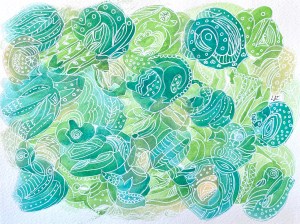
Watercolor and ink abstract
Making Our Marks
We sat on logs, rough with icy bark
beside a campfire rounded by stones,
built by one of the neighborhood boys,
a Boy Scout, in fact, therefore “qualified”
to light a match and start the hot blaze.
Or so he told us girls, pre-teens in our
snowpants, boots, hats, mittens, and scarfs,
sweat beading under our arms
while our noses ran from the cold.
We pulled off our boots, tugged on skates,
laced them: “crisscross, crisscross, tie, and knot,”
the way we’d been taught by an older sister,
or brother, or parent—who remembers?
It was a lifetime of winters ago.
Balancing on blades on trampled snow,
we clomped left, clomped right,
without gracefulness or finesse;
stepping into the footprints of others
until we reached the pond’s frozen edge,
where off we glided on cleared ice
past the boys and the “clack, clack, clack”
of their hockey sticks, leaving behind
their shouts carried on cold breath.
Claiming our own side
of the neighborhood pond with only
the sounds of birds and wind
to accompany our dance,
we glided around and around,
making our marks,
arms and legs fluid and strong.
We practiced coming to a stop,
one tip of our skates pointed
as if we were ballerinas in slippers,
arms raised above heads towards the sky,
believing we’d always be this wild, this alive.
Every Garden Tells a Story
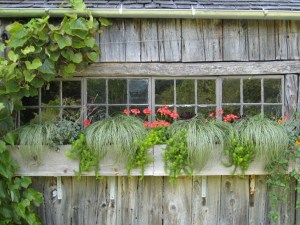
Photograph taken at Berkshire Botanical Garden
Bright greenery and pinkish-red geraniums against shades of weathered gray catch my eye. I want to take this barn garden home with me. My shoulders rise in a smile as I steady my camera to take a photograph.
I’m tempted to run my fingers over the texture of the knotted barn boards, but childhood memories of splinters stop me short. Instead, I touch the green plants—I’m pricked anyway by their spiky nature. Determined, I stroke the ornamental grass that flows over the window box like hair down a woman’s back.
The old paint on the window frames and sash bars is flaking. The knots in the wood have cracked and splintered with age. Tree rings hint at the width of limbs before they were lopped off. Yet the geraniums pop with color and the grasses and grape vines thrive.
Sturdy twine is strung from the base of the barn up to its roofline, and then horizontally across the vertical boards for the grape vines to follow. And they do—flush with lobed grape leaves. In the glass panes, I see the reflection of leafy trees and gray-blue sky behind me.
I want to meet this garden’s artist and tell him or her how this painting—made from wood and plants, glass and twine—speaks to me. It tells a story not only of aging and weathering the storms, but also of the young growing with vigor, reaching high to follow a path. It also reminds me that sometimes we just need to let our hair hang down.
Rose Fantasy
Lightning bugs burst like
fireworks on black velvet sky—
roses ooh and aah.
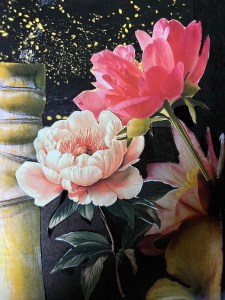
Handcut magazine collage
The collage “Rose Fantasy” and haiku were first published in Touchstone, Volume 68.1 by the Poetry Society of New Hampshire.
Sedona Light
Outside the chapel,
red rock radiates sunlight—
inside, candles glow.
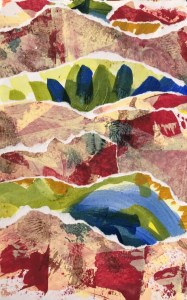
Acrylic collage abstract
Trail Guide
Walk on a bronze sea of pine needles
until the whites of winter’s eyes
stare you down. Wait—
for a moonlit night,
and glide
through innumerable stars in snow.
“Trail Guide” won the Poetry in the Pines contest in 2026. This poem is displayed on the Peace Trail at the Cathedral of the Pines in Rindge, New Hampshire.
Intention
You can drop a stone,
any stone,
out of your open hand,
straight down into a pond—
a watery end.
Or, you can choose one,
oval and smooth, then
with a practiced flick
of the wrist,
skip it across the pond.
With each bounce
comes a sparkling spray
of liquid exclamation points.
A stone defying gravity—
for now.
The end is the same:
a stone in a pond.
But did you see it fly?
“Intention” was first published in The Poet’s Touchstone, Volume 64, Number 2 by the Poetry Society of New Hampshire.
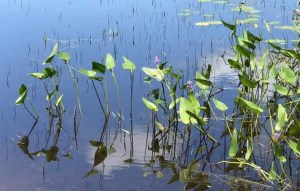
Photograph taken in Peterborough, New Hampshire
Author photograph by Bob Meagher. All other images by Linda J. Thomas.
off the margins contributors are asked to respond to questions to further articulate a collective response to the question: How do we step off the margins of convention and enter the wild terrain of our writing?
In what way(s) do you identify yourself as a woman writer?
I thought of myself as a writer early on—about age eight—long before I became a woman writer. I was enamored with written language, books full of stories and poetry, and I loved to write my own poetry. Of course, growing up in the 1960s, I was aware that women were largely assigned roles as wife and mother, especially in my family and suburban neighborhood. I remember reading Little Women by Louisa May Alcott and feeling determined to be a writer despite societal expectations. If Louisa could do it in her day, so could I, and the women’s movement in the 1970s affirmed my aspirations.
I wrote creatively all through school, both inside and outside the classroom, and studied the work of women writers in college whenever I could find an elective course on the subject. Since 2020, I’ve met weekly with a group of women writers—we call ourselves the Riverbank Writers. We take turns bringing poems by our favorite poets to serve as prompts for each writing session. We listen to each other’s words about common themes—the beauty of nature, relationships, grief, and gratitude. In 2025, we completed a print anthology of our poetry, essays, and artwork, titled Women at the River of Words.
Whose voices have you carried with you for creative strength in order to arrive at this point in your writing career?
One of my favorite poets, Mary Oliver, gives me creative strength not only for writing but for living itself. Her gift to see and express life-sized themes in the smallest details of nature both inspires and sustains me. I also love the poetry of Jane Kenyon and Marge Piercy, the essays of May Sarton and Edie Clark, and young adult literature by Renée Watson. What I feel and where my mind wanders, after reading their work, reassures me that I’m not alone in my search for meaning and goodness.
Professors in the Creative Writing Program at UCLA boosted my confidence and encouraged me to keep writing. I learned so much about writing memoir, essays, and poetry from Sonja Livingston (author of Ghostbread, a childhood memoir), Victoria Zackheim (editor of The Face in the Mirror, a collection of essays), and Anna Maria Hong (author of Age of Glass, a poetry book).
What do you want our readers to know about your process of becoming a writer that might be helpful in further articulating their own individual process and growth?
Becoming a writer has been a journey for me from childhood to retirement. I’ve learned that there are many paths to choose from for that journey, and one can choose the path that works the best for them at any given time. Though I became a technical writer in the corporate world in order to support myself, creative writing has always been my first love. Throughout my career, I stayed connected with it through continuing education classes and writing organizations. Now that I’m retired, my focus is once again on writing poetry and essays.
Also, combining my writing practice with photography and other arts has encouraged my entire creative self to grow. I’ve always dabbled in arts and crafts and enjoyed taking photographs. In High School, I enrolled in a creative arts class (rather than chemistry) despite my guidance counselor’s advice. I was learning to push the margins beyond the assumed path of a college-bound student. One gift of retirement is having the time to explore art in classes—watercolor painting, mixed media collage, and handmade books. My first class in bookmaking was taught by local artist, Erin Sweeney, who helped me further express my love for books through making them with my own hands.
Artist Statement
The resilient beauty of the natural world has always inspired me to create, to try to capture its magic and lessons. When writing, I also explore my memories of the people, places, and passages in my life. And I write to be part of a community—sharing our stories helps us understand how much we have in common. When I switch from a pen to a paint brush, I’m learning how color, texture, lines, and shapes come together to tell a story. For me, creating can be meditative, often playful, and always healing.
Biography
I live in view of the mountains in the Monadnock Region of New Hampshire. I enjoy exploring New England on nature walks with my husband, Bob, and through the lens of my camera. I’m a co-founder and editor of Smoky Quartz, published by the Monadnock Writers’ Group, and the founding editor of New England Memories. I completed the Creative Writing Program at UCLA after earning master’s degrees in Technical Writing and Educational Studies. In addition to writing for adult readers, I write poetry and stories for children. My work has been published in a number of anthologies. You can follow me on Bluesky (lindajeantm.bsky.social) where I participate in writing and art communities.

